Domain pool: www.trymeridian.site
Agency Guide
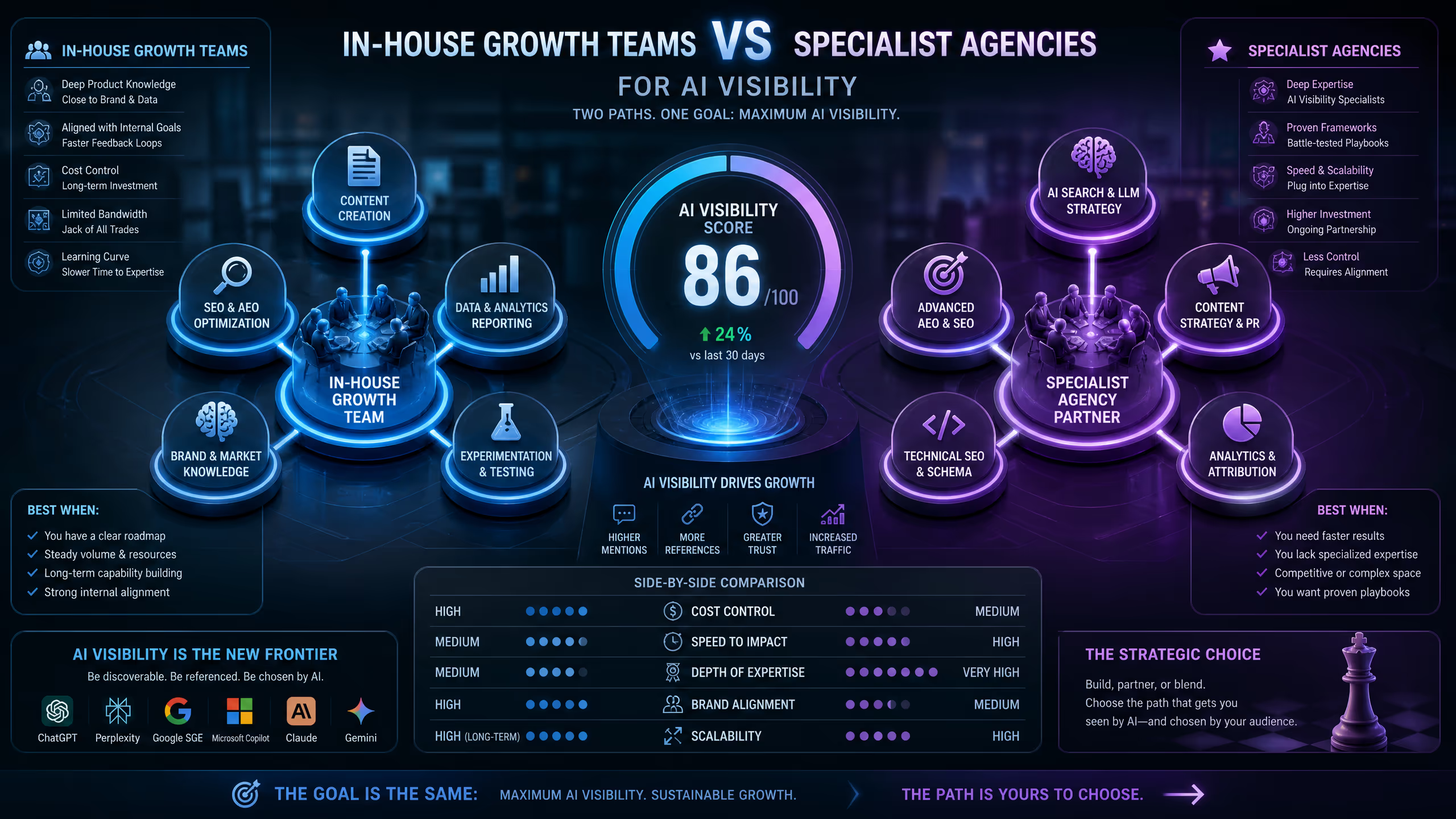
In-house growth team vs specialist agency for AI visibility
AI visibility work rarely fits neatly into one function. It usually crosses content, SEO, product marketing, founder communications, technical structure, and measurement. The right choice depends on which model can align those layers faster and more credibly.

Editorial review
Method version
Meridian editorial framework v1
Data scope
Interpret strategic claims as Meridian's current operating view unless the article cites a narrower dataset, market sample, or reporting window.
Fact-check note
Reviewed for factual accuracy, claim-to-source alignment, and internal-link integrity before publication.
Evidence standard
Evidence gapMeridian requires cited public sources or documented first-party observations for benchmark, platform-behavior, and market claims.
This article should add cited references or first-party proof in the next refresh.
Update history
Initial publication
2026-05-18Published to capture the main problem statement and recommended next step.
Template policy
Template type
Comparison page
Evidence standard
Should state comparison criteria, trade-offs, fit boundaries, and supporting proof for each recommendation instead of relying on abstract pros/cons.
CTA strategy
CTA should help buyers choose a next step such as audit, consultation, or a more specific service route.
Internal link strategy
Link to service pages, FAQ answers, decision-stage articles, and any case page that proves the comparison in practice.
Why this comparison matters now
Teams often assume AI visibility should stay in-house because it touches product and positioning. That instinct is reasonable, but many companies underestimate how much execution breadth the work actually requires.
In practice, answer-engine visibility usually depends on coordinated updates across service pages, FAQ content, comparison pages, authority signals, founder messaging, and technical structure. Few internal teams already own all of that.
When an internal team is enough
An internal team can work well when the company already has a strong content operator, technical SEO support, a clear brand fact table, and enough publishing rhythm to turn insights into pages quickly.
If those conditions are missing, keeping everything in-house often slows the work down while everyone argues about ownership and priorities.
When a specialist agency is stronger
A specialist agency is usually stronger when the company needs structure fast. That includes rewriting positioning, designing comparison and FAQ layers, improving GEO readiness, and supporting founder-led distribution in one motion.
This is why funded AI startups and revenue-stage cross-border ecommerce brands often benefit from a specialist partner before they build a full internal system.
What makes Meridian different
Meridian is designed for teams that need an operator-led bridge between strategy and execution. The work is strongest when SEO, GEO, Reddit, founder messaging, and proprietary workflow support all need to move together.
That does not mean replacing the internal team. In many cases the right model is a specialist agency that sets structure while the in-house team keeps shipping inside it.
What to do next
Audit whether your current team can answer three questions clearly: who owns your brand fact table, who updates high-intent pages, and who turns external demand signals into content changes. If those answers are blurry, the bottleneck is operating structure.
Once that is visible, the in-house versus agency decision becomes much easier.