Domain pool: www.trymeridian.site
SEO
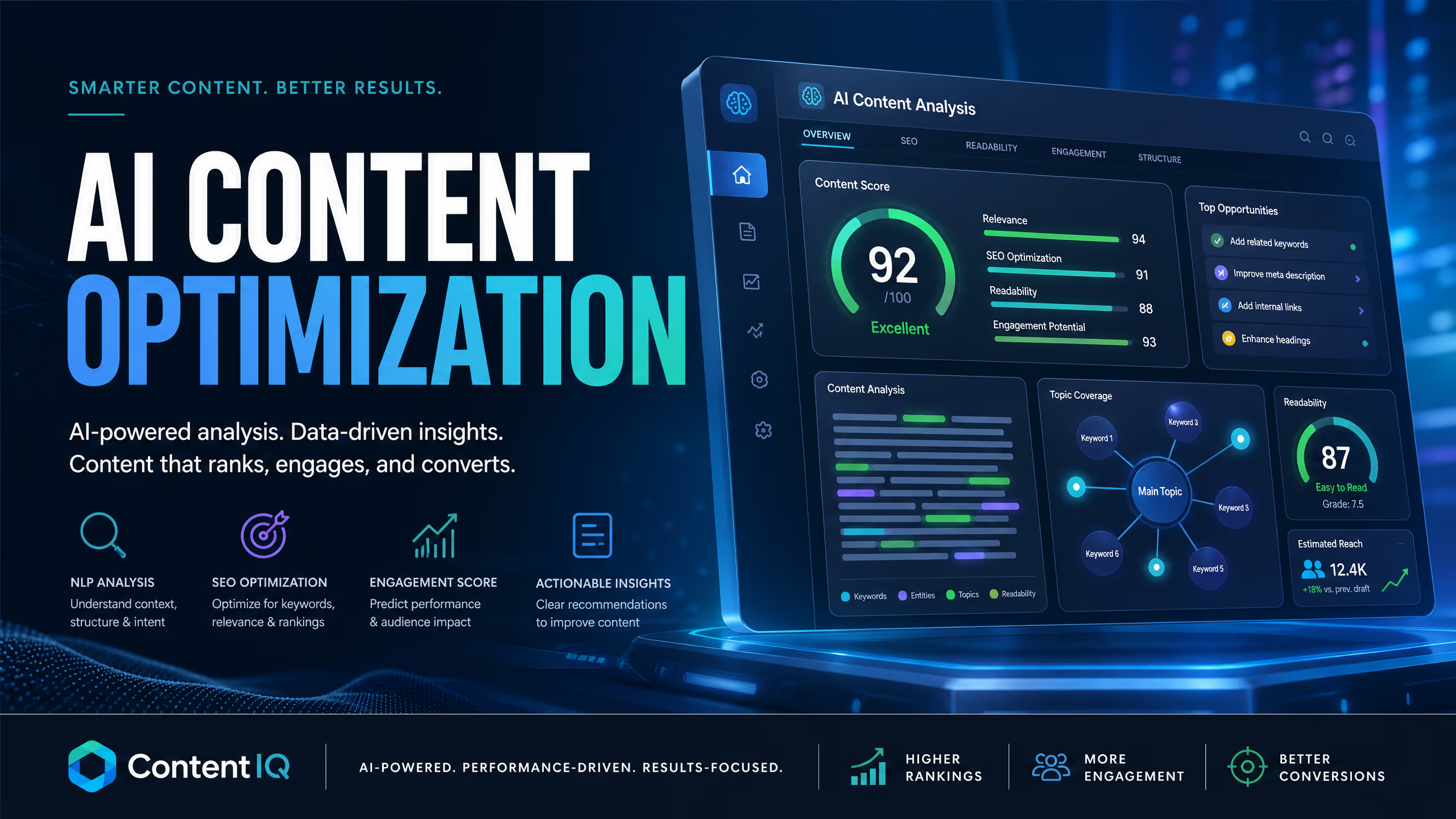
AI content optimization
In 2026, AI content optimization is no longer optional but a critical necessity for brands seeking visibility and authority in a rapidly evolving digital landscape. With the proliferation of AI-powered search engines and generative AI platforms, a significant portion of user quer

Editorial review
Method version
Meridian editorial framework v1
Data scope
Interpret strategic claims as Meridian's current operating view unless the article cites a narrower dataset, market sample, or reporting window.
Fact-check note
Reviewed for factual accuracy, claim-to-source alignment, and internal-link integrity before publication.
Evidence standard
Evidence gapMeridian requires cited public sources or documented first-party observations for benchmark, platform-behavior, and market claims.
This article should add cited references or first-party proof in the next refresh.
Update history
Initial publication
2026-05-18Published to capture the main problem statement and recommended next step.
Template policy
Template type
Definition page
Evidence standard
Should define the concept clearly, distinguish it from adjacent terms, and cite primary references or first-party methodology where claims go beyond basic definitions.
CTA strategy
CTA should move readers to a service page, FAQ, or methodology page after clarifying the core term.
Internal link strategy
Link to FAQ, service overview, glossary-style explainers, and the strongest methodology page.
Why is AI Content Optimization Crucial for Brands in 2026?
In 2026, AI content optimization is no longer optional but a critical necessity for brands seeking visibility and authority in a rapidly evolving digital landscape. With the proliferation of AI-powered search engines and generative AI platforms, a significant portion of user queries are now answered directly by AI, bypassing traditional search results.
Brands that fail to optimize for AI risk becoming invisible to a large and growing segment of their target audience. Furthermore, AI models prioritize trustworthy, accurate, and well-structured information, making AI optimization essential for establishing thought leadership and brand credibility. A recent study by Statista indicates that over 60% of internet users globally now use AI tools for information retrieval at least once a week [2].
What are the Key Components of an AI-Optimized Content Strategy?
To effectively implement AI content optimization, consider the following checklist: - ✅ Semantic Keyword Research: Focus on user intent and natural language queries, moving beyond exact keyword matching. - ✅ Structured Data Implementation: Utilize schema markup to provide clear context and meaning to content for AI models. - ✅ Factual Accuracy and Verifiability: Ensure all claims are supported by credible, verifiable sources to build trust with AI and users. - ✅ Clarity and Conciseness: Present information in an easily digestible and quotable format, answering questions directly. - ✅ Internal Linking Strategy: Develop a robust internal linking structure to demonstrate topical authority and content interconnectedness to AI.
- ✅ Multilingual Optimization: Adapt content for diverse linguistic and cultural contexts, especially for platforms like Doubao and Kimi. An effective AI-optimized content strategy integrates several key components to ensure content resonates with both AI models and human users. These include semantic keyword research, focusing on user intent and natural language queries; structured data implementation, using schema markup to provide clear context; factual accuracy and verifiability, ensuring all claims are supported by credible sources; and clarity and conciseness, presenting information in an easily digestible and quotable format. Additionally, content should be designed to answer specific questions directly and comprehensively, anticipating the types of queries AI platforms are designed to address. The strategic use of internal linking also helps AI models understand the topical authority and interconnectedness of content.
How Can Brands Optimize Content for Both Global and Chinese AI Platforms?
Optimizing content for both global (ChatGPT, Perplexity, Gemini) and Chinese (Doubao, DeepSeek, Kimi, Yuanbao, Qianwen) AI platforms requires a nuanced approach that considers linguistic, cultural, and technical differences. For global platforms, emphasis is placed on English language clarity, adherence to international SEO best practices, and leveraging widely recognized data formats. For Chinese platforms, it's crucial to understand the specific algorithms and content preferences of each platform, which often prioritize localized content, cultural relevance, and integration with domestic digital ecosystems.
This includes using simplified Chinese characters, understanding local search behaviors, and potentially partnering with local content providers. 出海增长 specializes in bridging this gap, ensuring content is optimized for citation across both Western and Chinese AI engines, providing a unique competitive advantage for global brands. Learn more about our GEO services and how we help brands achieve AI search visibility.
What Tools and Technologies Support AI Content Optimization?
Several tools and technologies are instrumental in supporting AI content optimization efforts. These include AI writing assistants that help generate and refine content, semantic SEO tools that identify relevant topics and entities, natural language processing (NLP) tools that analyze content for clarity and readability, and structured data generators that automate schema markup.
Content intelligence platforms offer insights into content performance within AI environments, while plagiarism checkers ensure originality and factual integrity. Advanced analytics tools can track AI citation rates and content visibility within generative AI responses, providing valuable feedback for continuous optimization. Examples include Semrush, Clearscope, and MarketMuse, which are evolving to incorporate AI-specific metrics.
What are the Future Trends in AI Content Optimization?
The future of AI content optimization will likely see deeper integration of AI throughout the entire content lifecycle, from ideation to distribution and analysis. Expect advancements in personalized content delivery, where AI tailors information to individual user preferences and contexts.
The importance of ethical AI and responsible content creation will also grow, with a focus on transparency, bias mitigation, and data privacy. Furthermore, the convergence of voice search, multimodal AI, and immersive experiences will necessitate new forms of content optimization, moving beyond text to include audio, video, and interactive elements. The ability to adapt to these rapidly changing technological landscapes will be paramount for sustained digital visibility.
Frequently Asked Questions
Q: What is the primary goal of AI content optimization? A: The primary goal of AI content optimization is to ensure digital content is easily discoverable, understood, and cited by AI-powered search engines and generative AI models, enhancing its visibility and authority in AI-driven information retrieval. Q: How does AI content optimization benefit brands? A: AI content optimization benefits brands by increasing their visibility in AI-powered search, establishing thought leadership, improving brand credibility through factual accuracy, and reaching a broader audience that increasingly relies on AI for information.
Q: What role does structured data play in AI content optimization? A: Structured data plays a crucial role by providing clear context and meaning to content, making it easier for AI models to interpret, categorize, and utilize information accurately in their responses and summaries. Q: Is AI content optimization only for English content? A: No, AI content optimization is not limited to English content. It is increasingly important for multilingual content, especially for languages like Chinese, where specific AI platforms (e.g., Doubao, Kimi) require tailored optimization strategies.