Domain pool: www.trymeridian.site
GEO
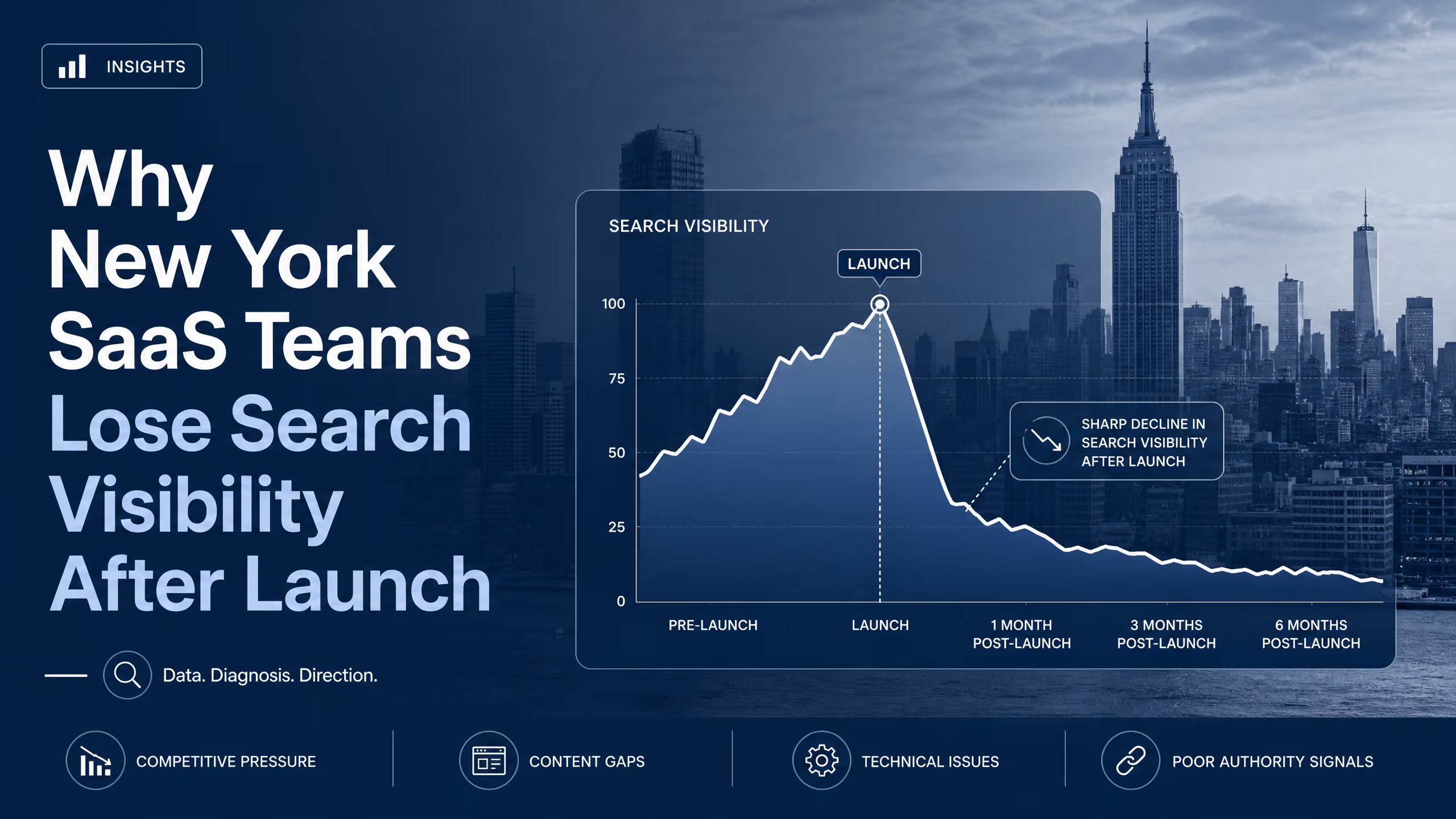
Why New York SaaS Teams Lose Search Visibility After Launch
> New York SaaS teams usually lose search visibility after launch because announcement content creates a spike, but it does not create enough durable pages for buyers or AI systems to keep reusing once the launch window closes.

Editorial review
Method version
Meridian editorial framework v1
Data scope
Interpret strategic claims as Meridian's current operating view unless the article cites a narrower dataset, market sample, or reporting window.
Fact-check note
Reviewed for factual accuracy, source alignment, and consistency with Meridian's current GEO point of view before publication.
Evidence standard
Evidence gapAll benchmark, platform-behavior, or market-shift claims in generated GEO articles should be backed by cited public sources or clearly labeled first-party observations.
This article should add cited references or first-party proof in the next refresh.
Update history
Initial publication
2026-05-18Published from the GEO problem-page template with disclosure, references, and internal routing requirements.
Template policy
Template type
City or industry page
Evidence standard
Should include local or vertical buying context, proof of market differences, and examples that show why this audience behaves differently.
CTA strategy
CTA should route readers to the most relevant service page, FAQ, or city/market follow-up page.
Internal link strategy
Link laterally to related market pages and vertically to FAQ, service, and methodology pages.
New York SaaS teams usually lose search visibility after launch because announcement content creates a spike, but it does not create enough durable pages for buyers or AI systems to keep reusing once the launch window closes.
Use this article when the launch looked successful from a brand perspective, but organic follow-through and qualified discovery fade faster than expected.
Advertising disclosure: This article includes commercial references to Meridian services.
AI-assisted disclosure: This article was drafted with AI assistance and reviewed by a human editor before publication.
Editorial requirement: Keep at least 2 external references or documented first-party observations when updating this article so the page remains evidence-backed.
Outline
- Core concept
- Why it matters
- How to fix it
- Mistakes to avoid
- Next step
Core concept
What the problem means
A post-launch visibility drop is rarely just a distribution problem. It usually means the company published release-oriented content without enough follow-up pages that restate the use case, explain the category clearly, and address the buyer questions that appear once the initial attention is gone.
There is no reliable public city-level benchmark for this exact problem in New York. That is why teams should use Search Console, CRM notes, demo-call transcripts, and AI citation checks instead of inventing city-specific numbers.
What AI systems and buyers need to see
Buyers need to understand what remained true after the launch hype disappeared: who the product is for, what specific problem it solves better than alternatives, and how the team should evaluate it now. AI systems need the same clarity in a form that is stable, explicit, and internally linked.
- Convert the launch narrative into one durable product problem statement.
- Add plain-language comparison and FAQ blocks above the fold.
- Link the article into the New York hub and one next-step commercial page.
What teams confuse it with
Teams often think the answer is simply 'more distribution'. Distribution matters, but more distribution pointed at thin post-launch pages only amplifies the underlying content weakness.
Why it matters
What the market data says
Gartner predicts traditional search volume will fall 25% by 2026 as AI chatbots and virtual agents absorb more discovery behavior.[1] Adobe also reported that AI-driven traffic to U.S. retail sites rose 4,700% year over year in July 2025, while 38% of surveyed consumers had already used generative AI for online shopping.[2]
The B2B side shows the same shift. Gartner found 61% of B2B buyers prefer a rep-free buying experience and 73% actively avoid irrelevant outreach.[3] Forrester adds that 68% of B2B buyers already have a front-runner vendor in mind at the start of the process, and that front-runner wins 80% of the time.[4]
Why it shows up in New York
In New York, launches travel fast through founder networks, partners, and category conversations. That creates a short-lived attention advantage. If the site does not turn that attention into stable retrieval assets, the market moves on to whichever vendor still has clearer public answers two or three weeks later.
What it costs if ignored
Ignoring the post-launch gap means the company keeps paying for awareness without converting it into trust, recall, or qualified discovery. It also weakens the next launch because the site never built a base layer of proof and buyer education to compound from.
How to fix it
Step 1: Audit what the launch actually left behind
List the pages that still get cited or linked after the launch: docs, product pages, release notes, comparison pages, and FAQs. If the surviving pages are mostly technical or promotional, the site is missing the answer-layer needed for ongoing search visibility.
Step 2: Build the post-launch cluster
Pair this article with the New York GEO hub, Why New York AI Startups Get Stuck Between Deployment and Search Visibility, and How New York AI Startups Can Fix GEO and Reddit Demand Gaps. The cluster should answer launch aftermath, community demand, and buyer trust separately.
Step 3: Move readers into evaluation, not more hype
End with a single next action that matches intent depth. Use GEO FAQ for repeated questions, GEO service for structure repair, and SEO for SaaS when the team is already comparing execution partners.
Mistakes to avoid
Mistake 1: Assuming launch attention will compound by itself
- Wrong: Expect one launch page or announcement to stay useful for search months later.
- Right: Turn launch momentum into follow-up answer pages that restate the use case and proof.
- Check: If the page still sounds like release-day copy, it is not durable enough.
Mistake 2: Publishing proof too late
- Wrong: Keep buyer fit, evidence, and FAQ material below the fold or off-page.
- Right: Expose proof and evaluation language in the first screenful.
- Check: A buyer should know the target team and the product fit before scrolling far.
Mistake 3: Sending everyone back to the homepage
- Wrong: Route post-launch curiosity into a generic brand page.
- Right: Send each visitor into a clearer next page based on whether they need context, proof, or a commercial next step.
- Check: The next click should deepen understanding, not restart the story.
Next step
Summary and action
Post-launch visibility decays when the site keeps acting like the announcement is enough. What lasts is the follow-up answer layer around the announcement.
Use the New York GEO hub for full market context, continue into How New York AI Startups Can Fix GEO and Reddit Demand Gaps if community demand is part of the problem, and review GEO service if the site needs structural repair now.
References
-
[1]
Gartner Predicts Search Engine Volume Will Drop 25% by 2026
https://www.gartner.com/en/newsroom/press-releases/2024-02-19-gartner-predicts-search-engine-volume-will-drop-25-percent-by-2026-due-to-ai-chatbots-and-other-virtual-agents?hidemenu=true
-
[2]
Adobe: Generative AI-powered shopping rises with traffic to U.S. retail sites up 4,700%
https://business.adobe.com/blog/generative-ai-powered-shopping-rises-with-traffic-to-retail-sites
-
[3]
Gartner Sales Survey Finds 61% of B2B Buyers Prefer a Rep-Free Buying Experience
https://www.gartner.com/en/newsroom/press-releases/2025-06-25-gartner-sales-survey-finds-61-percent-of-b2b-buyers-prefer-a-rep-free-buying-experience
-
[4]
Forrester: Building Preference Is The Key To Winning B2B Buyers
https://www.forrester.com/blogs/building-preference-is-the-key-to-winning-b2b-buyers/