Domain pool: www.trymeridian.site
SEM
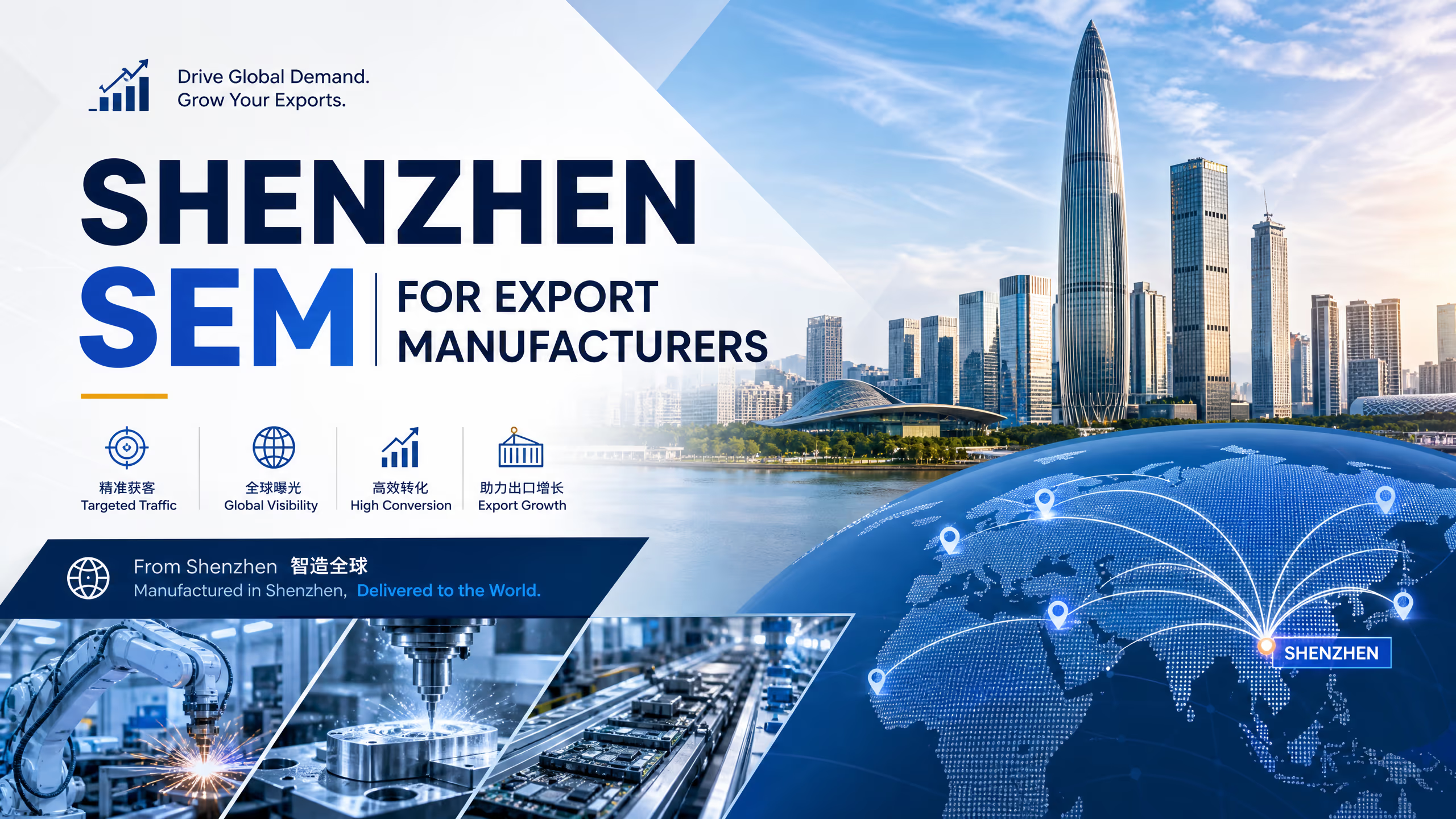
Shenzhen SEM for Export Manufacturers: How To Turn Search Ads Into Better RFQs
> Shenzhen SEM for export manufacturers should turn search demand into qualified pipeline by separating buyer intent, matching each query to a focused landing page, and filtering poor-fit clicks before sales spends time on them. In this market, the main...

Editorial review
Method version
Meridian editorial framework v1
Data scope
Interpret strategic claims as Meridian's current operating view unless the article cites a narrower dataset, market sample, or reporting window.
Fact-check note
Reviewed for factual accuracy, source alignment, and consistency with Meridian's current point of view before publication or refresh.
Evidence standard
Evidence gapClaims about benchmarks, platform behavior, or market shifts should include cited public sources or clearly labeled first-party observations whenever available.
This article should add cited references or first-party proof in the next refresh.
Update history
Initial publication
2026-05-18Published as part of Meridian's blog library and aligned with the current editorial review standard.
Template policy
Template type
City or industry page
Evidence standard
Should include local or vertical buying context, proof of market differences, and examples that show why this audience behaves differently.
CTA strategy
CTA should route readers to the most relevant service page, FAQ, or city/market follow-up page.
Internal link strategy
Link laterally to related market pages and vertically to FAQ, service, and methodology pages.
Shenzhen SEM for export manufacturers should turn search demand into qualified pipeline by separating buyer intent, matching each query to a focused landing page, and filtering poor-fit clicks before sales spends time on them. In this market, the main challenge is improving RFQ quality by making quote logic, MOQ, delivery, and trust signals clear before inquiry.
Advertising disclosure: This article includes commercial references to Meridian services.
AI-assisted disclosure: This article was drafted with AI assistance and reviewed by a human editor before publication.
Outline
- Core answer
- Why it matters
- How to build the program
- Pitfalls and mistakes
- Next step
Core answer
What Shenzhen SEM needs to accomplish
For export manufacturers in Shenzhen, SEM should do three jobs at once: capture explicit demand, answer commercial objections fast, and route only qualified buyers into sales. If the account only buys traffic, it will create lead volume without moving real pipeline.
What makes this market different
Shenzhen export demand is often spec-heavy. Buyers usually want to know product scope, MOQ, lead time, certification, and production readiness before they commit to an RFQ. When pages hide those details, ads buy low-quality inquiries.
There is no reliable public city-level benchmark for one universal CPC, CAC, or conversion rate in Shenzhen. Teams should use their own search-term reports, CRM notes, sales-stage progression, and opportunity quality instead of repeating market folklore.
Why it matters
What the data says
Google explains that Ad Rank depends on bid, ad quality, asset impact, and auction context.[1] Google also states that Quality Score reflects expected CTR, ad relevance, and landing-page experience, which means post-click clarity directly affects efficiency.[2]
The buyer side makes this even more important. Gartner reports that 61% of B2B buyers prefer a rep-free buying experience.[3] Forrester adds that 68% of B2B buyers start with a preferred vendor and that front-runners win 80% of the time.[4]
Why teams waste budget in Shenzhen
The most common problem is sending quote-intent traffic to a generic company page with no product constraints, no fulfillment detail, and no trust signals. That raises inquiry volume while lowering RFQ quality.
How to build the program
Step 1: Split campaigns by buyer task
Use separate campaigns or ad groups for the keyword clusters below. Each cluster should have its own ad promise, exclusions, and landing-page match.
- Supplier and factory demand: oem manufacturer china, factory supplier shenzhen, custom electronics manufacturer
- Quote and MOQ demand: request quote manufacturer, low moq supplier, bulk order electronics factory
- Compliance and export demand: export certified manufacturer, ce compliant supplier, manufacturing quality control china
- Distributor and sourcing demand: private label supplier, electronics distributor source, oem sourcing partner china
Step 2: Build landing pages that answer the query immediately
The first screen should state who the offer is for, what problem it solves, what proof exists, and what happens after the click or form submission. For Shenzhen programs, the highest-value proof blocks are:
- Show product categories, MOQ logic, and lead-time expectations above the fold.
- Add applicable certification, QA, packaging, and export-process proof.
- Use factory, production, or inspection visuals that reduce trust gaps for first-time buyers.
- Explain what information the buyer should prepare before requesting a quote.
Step 3: Qualify before the form
Commercial pages should filter poor-fit traffic early. Use qualification and FAQ content before the form so buyers can self-sort instead of asking sales to clean up the mismatch later.
- Ask for product type, target quantity, destination market, and required certification.
- Use FAQ sections to answer MOQ, sample policy, lead time, and shipping readiness.
- Make non-fit scenarios explicit so small or mismatched inquiries drop off earlier.
- Create separate routes for OEM, distributor, and repeat-buyer conversations when possible.
Step 4: Measure pipeline quality, not just lead volume
Weekly review should not stop at CTR or CPL. Teams should inspect:
- RFQ quality by product category, quantity band, and destination market.
- Search terms that attract low-intent sourcing or student research traffic.
- Sales feedback on missing specs, unrealistic volumes, or non-fit certification requests.
- Form completion by fields related to MOQ, quantity, and compliance.
Pitfalls and mistakes
Mistake 1: Using trust-light company pages for quote traffic
- Wrong: Send commercial buyers to a page that only says the factory is experienced.
- Right: Show product scope, production constraints, and buyer-ready proof before the form.
Mistake 2: Hiding qualification details
- Wrong: Wait until email follow-up to ask for quantity, certification, or destination market.
- Right: Collect the core RFQ qualifiers on-page so sales receives better inquiries from day one.
Mistake 3: Judging success by inquiry count alone
- Wrong: Increase spend because lead volume rose, even as quote quality fell.
- Right: Review accepted RFQs, sample requests, and downstream conversion quality before scaling.
Next step
Summary and action
Shenzhen SEM works best when keyword structure, ad copy, landing pages, and qualification logic are designed as one system. In most cases, the highest-leverage improvement is not another bid experiment. It is better intent separation, stronger post-click clarity, and cleaner qualification before sales gets involved.
Start by mapping your top search terms into the clusters above, rewriting the first screen of each landing page, and reviewing disqualified leads from the last 30 days. Then connect this work to SEM service, SEO service, and SEO for Manufacturing.
References
-
[1]
Google Ads Help: About Ad Rank
https://support.google.com/google-ads/answer/1722122
-
[2]
Google Ads Help: About Quality Score
https://support.google.com/google-ads/answer/6167118
-
[3]
Gartner Sales Survey Finds 61% of B2B Buyers Prefer a Rep-Free Buying Experience
https://www.gartner.com/en/newsroom/press-releases/2025-06-25-gartner-sales-survey-finds-61-percent-of-b2b-buyers-prefer-a-rep-free-buying-experience
-
[4]
Forrester: Building Preference Is The Key To Winning B2B Buyers
https://www.forrester.com/blogs/building-preference-is-the-key-to-winning-b2b-buyers/