Domain pool: www.trymeridian.site
GEO
Shenzhen Factory Content Mistakes That Cause Quote Confusion
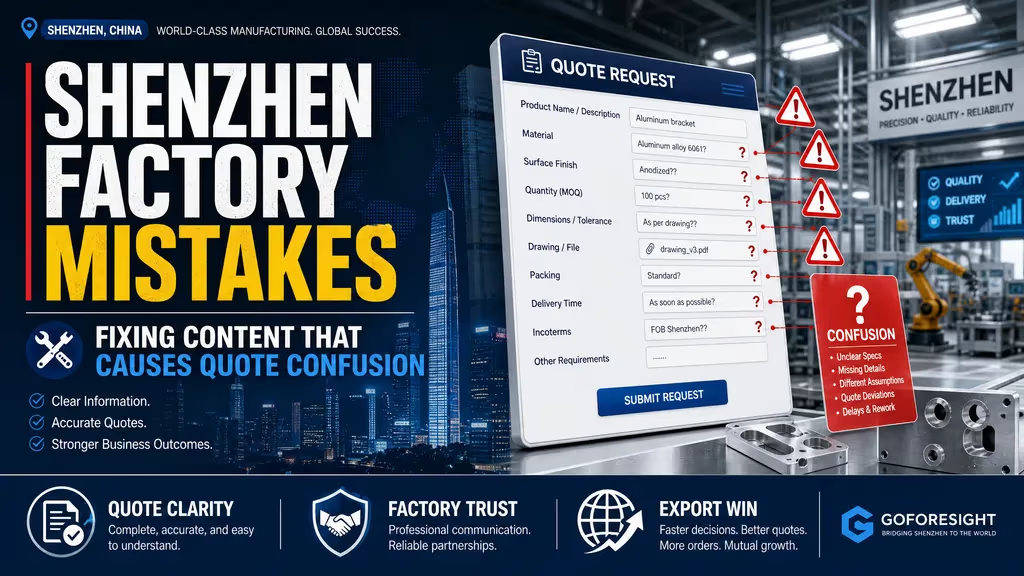
> Shenzhen factories create quote confusion when the page talks about capability in broad terms but never explains what the quote includes, what changes price, and what the buyer should prepare before the quotation can move forward.

Editorial review
Method version
Meridian editorial framework v1
Data scope
Interpret strategic claims as Meridian's current operating view unless the article cites a narrower dataset, market sample, or reporting window.
Fact-check note
Reviewed for factual accuracy, source alignment, and consistency with Meridian's current GEO point of view before publication.
Evidence standard
Evidence gapAll benchmark, platform-behavior, or market-shift claims in generated GEO articles should be backed by cited public sources or clearly labeled first-party observations.
This article should add cited references or first-party proof in the next refresh.
Update history
Initial publication
2026-05-18Published from the GEO problem-page template with disclosure, references, and internal routing requirements.
Template policy
Template type
City or industry page
Evidence standard
Should include local or vertical buying context, proof of market differences, and examples that show why this audience behaves differently.
CTA strategy
CTA should route readers to the most relevant service page, FAQ, or city/market follow-up page.
Internal link strategy
Link laterally to related market pages and vertically to FAQ, service, and methodology pages.
Shenzhen factories create quote confusion when the page talks about capability in broad terms but never explains what the quote includes, what changes price, and what the buyer should prepare before the quotation can move forward.
Use this article when quote requests exist but buyers keep hesitating, asking repetitive pricing questions, or misreading the scope of the offer.
Advertising disclosure: This article includes commercial references to Meridian services.
AI-assisted disclosure: This article was drafted with AI assistance and reviewed by a human editor before publication.
Editorial requirement: Keep at least 2 external references or documented first-party observations when updating this article so the page remains evidence-backed.
Outline
- Core concept
- Why it matters
- How to fix it
- Mistakes to avoid
- Next step
Core concept
What the problem means
Quote confusion is a content design problem. Buyers delay when they cannot tell whether tooling, packaging, freight, documentation, compliance work, or after-sales support are included. The website should answer those recurring questions before the buyer has to chase them through email.
There is usually no public, city-specific benchmark for this exact export friction in Shenzhen. That makes first-party evidence critical: RFQ logs, sales replies, objection notes, and inquiry-to-quote conversion data.
What overseas buyers need to verify
Buyers want pricing logic they can compare, not a vague reassurance that the factory is competitive. They need to see what variables matter, what assumptions the quote depends on, and which operational changes will affect cost, lead time, or delivery.
- Break the quote into visible components instead of implying one all-in price.
- Explain what changes cost, lead time, or production complexity.
- Use one next step that fits quote-stage intent rather than generic inquiry language.
What teams confuse it with
Teams often think quote explanation belongs only in sales email. In reality, hiding all pricing logic until after contact makes the site feel harder to trust and harder to compare.
Why it matters
What the market data says
Gartner found 61% of B2B buyers prefer a rep-free buying experience, while 73% avoid suppliers that send irrelevant outreach.[1] That means buyers want to self-educate before they talk to a supplier. Forrester also found 68% of B2B buyers start with a front-runner already in mind, and that front-runner wins 80% of the time.[2]
BrightLocal reported that 85% of consumers consider contact information and opening hours an important factor when researching local businesses, and 40% of consumers actively use generative AI in search.[3] At the same time, Gartner predicts traditional search volume will drop 25% by 2026, which means supplier pages need to work for both direct buyers and AI-mediated discovery.[4]
Why it shows up in Shenzhen
Shenzhen suppliers often compete across categories where overseas buyers are already comparing several factories at once. If your quote page creates uncertainty while another supplier creates clarity, that clarity becomes a commercial advantage even before the final number is reviewed.
What it costs if ignored
If pricing logic stays vague, the factory loses time in clarification loops, attracts weaker-fit inquiries, and turns otherwise interested buyers into slower, less confident evaluators.
How to fix it
Step 1: Pull repeated quote objections into the page
Review the questions buyers keep asking after receiving a quotation. If MOQ, tooling, packaging, certification, or freight assumptions appear repeatedly, they belong in the article instead of only in the inbox.
Step 2: Connect quote explanation to the Shenzhen problem cluster
Use this page alongside the Shenzhen GEO hub, Why Overseas Buyers Stop Replying After RFQ for Shenzhen Factories, and How Shenzhen Manufacturers Can Build Local Inquiry Pages for US and EU Demand so pricing, reply quality, and market entry support each other.
Step 3: Add proof that makes the quote believable
Show one example of how price changes, one note on documentation or timing, and one trust path into Cases, GEO FAQ, or SEO for Manufacturing. Buyers should feel more certain after the page, not more dependent on follow-up guesswork.
Mistakes to avoid
Mistake 1: Calling the quote 'custom' without explaining the variables
- Wrong: Hide every pricing driver behind a generic promise of tailored quoting.
- Right: Name the operational factors that actually change price and delivery.
- Check: If the buyer cannot tell why two quotes might differ, the page is still too vague.
Mistake 2: Separating pricing from process
- Wrong: Explain price without clarifying lead time, packaging, freight, or documentation.
- Right: Treat quote clarity as one combined operational explanation.
- Check: A buyer should understand both the number and the process around the number.
Mistake 3: Ending with the same inquiry CTA as every other page
- Wrong: Ask for contact again without helping the buyer compare or verify the quote.
- Right: Route the reader into proof and process pages that reduce uncertainty first.
- Check: The next click should lower comparison friction, not repeat it.
Next step
Summary and action
Quote confusion drops when Shenzhen factories expose the logic behind the quotation instead of treating it like private knowledge.
Return to the Shenzhen GEO hub for the full export path, continue into Why Overseas Buyers Stop Replying After RFQ for Shenzhen Factories if replies are also weak, and use Cases when the buyer needs stronger credibility before moving forward.
References
-
[1]
Gartner Sales Survey Finds 61% of B2B Buyers Prefer a Rep-Free Buying Experience
https://www.gartner.com/en/newsroom/press-releases/2025-06-25-gartner-sales-survey-finds-61-percent-of-b2b-buyers-prefer-a-rep-free-buying-experience
-
[2]
Forrester: Building Preference Is The Key To Winning B2B Buyers
https://www.forrester.com/blogs/building-preference-is-the-key-to-winning-b2b-buyers/
-
[3]
BrightLocal Consumer Search Behavior 2025
https://www.brightlocal.com/research/consumer-search-behavior/
-
[4]
Gartner Predicts Search Engine Volume Will Drop 25% by 2026
https://www.gartner.com/en/newsroom/press-releases/2024-02-19-gartner-predicts-search-engine-volume-will-drop-25-percent-by-2026-due-to-ai-chatbots-and-other-virtual-agents?hidemenu=true