Domain pool: www.trymeridian.site
GEO
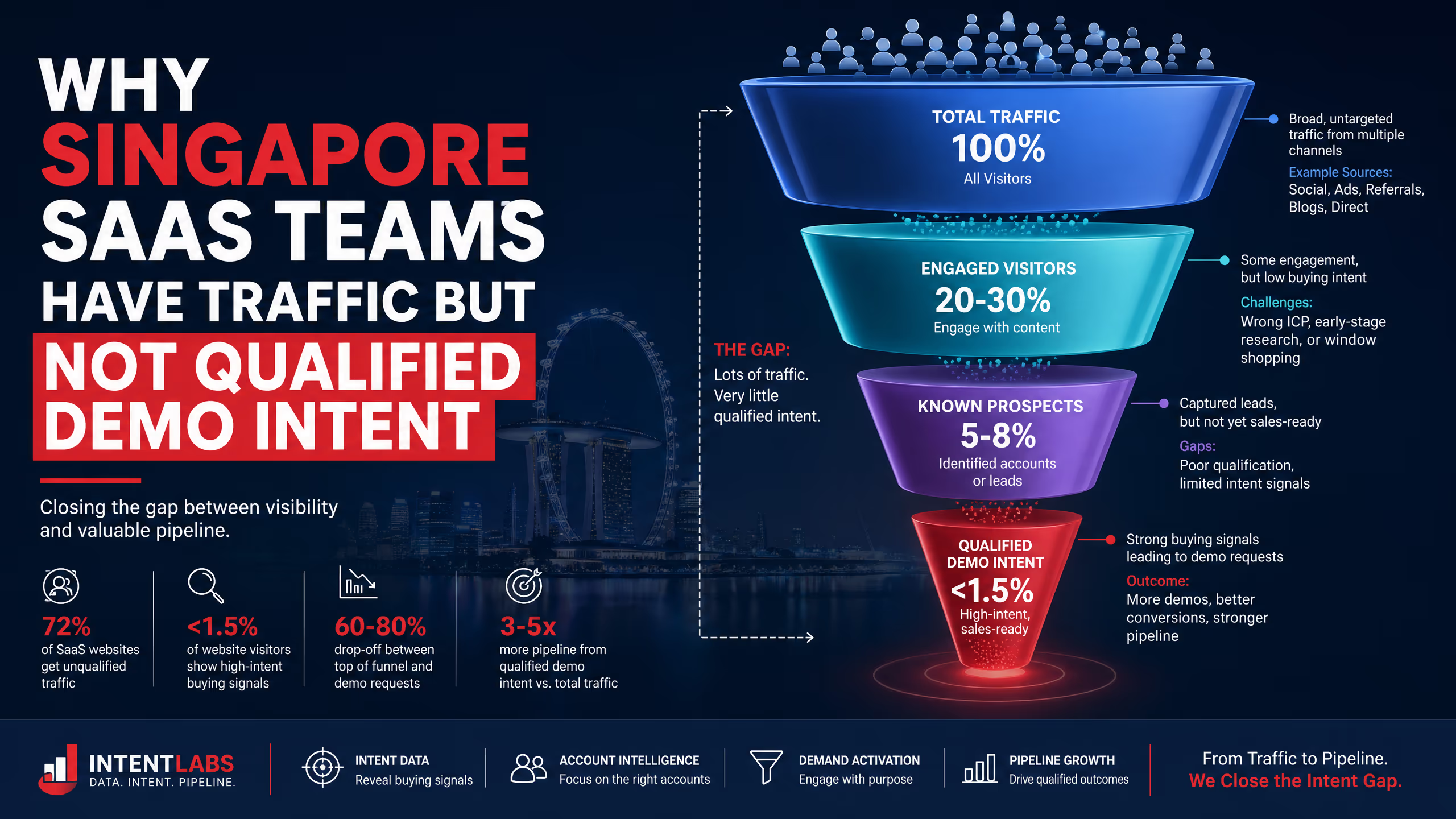
Why Singapore SaaS Teams Have Traffic but Not Qualified Demo Intent
> Singapore SaaS teams usually have traffic without qualified demo intent because one APAC-facing page tries to serve too many markets, too many team types, and too many buying stages at once.

Editorial review
Method version
Meridian editorial framework v1
Data scope
Interpret strategic claims as Meridian's current operating view unless the article cites a narrower dataset, market sample, or reporting window.
Fact-check note
Reviewed for factual accuracy, source alignment, and consistency with Meridian's current GEO point of view before publication.
Evidence standard
Evidence gapAll benchmark, platform-behavior, or market-shift claims in generated GEO articles should be backed by cited public sources or clearly labeled first-party observations.
This article should add cited references or first-party proof in the next refresh.
Update history
Initial publication
2026-05-18Published from the GEO problem-page template with disclosure, references, and internal routing requirements.
Template policy
Template type
City or industry page
Evidence standard
Should include local or vertical buying context, proof of market differences, and examples that show why this audience behaves differently.
CTA strategy
CTA should route readers to the most relevant service page, FAQ, or city/market follow-up page.
Internal link strategy
Link laterally to related market pages and vertically to FAQ, service, and methodology pages.
Singapore SaaS teams usually have traffic without qualified demo intent because one APAC-facing page tries to serve too many markets, too many team types, and too many buying stages at once.
Use this article when acquisition looks healthy across the region, but sales still reports noisy demos, broad curiosity, and weak commercial fit.
Advertising disclosure: This article includes commercial references to Meridian services.
AI-assisted disclosure: This article was drafted with AI assistance and reviewed by a human editor before publication.
Editorial requirement: Keep at least 2 external references or documented first-party observations when updating this article so the page remains evidence-backed.
Outline
- Core concept
- Why it matters
- How to fix it
- Mistakes to avoid
- Next step
Core concept
What the problem means
Traffic quality drops when the site never clarifies who should book now and who should keep learning. In Singapore, that problem gets amplified because one regional site often has to serve buyers from multiple markets with different vocabulary, urgency, and purchase readiness.
There is no reliable public city-level benchmark for this exact problem in Singapore. That is why teams should use Search Console, CRM notes, demo-call transcripts, and AI citation checks instead of inventing city-specific numbers.
What AI systems and buyers need to see
Buyers need the page to tell them whether the offer is meant for a regional operator, one local team, or a broader APAC rollout. AI systems need the same distinctions made explicit so they can summarize the page for the right audience instead of treating it as one more generic regional explainer.
- Name which audience should request a demo and which audience should continue reading.
- Separate regional education from commercial qualification.
- Use one CTA path that matches the maturity of the visitor instead of several competing asks.
What teams confuse it with
Teams often treat low demo quality as a channel problem. More often it is a qualification problem on-page: the site attracts attention but never states which problem, team profile, or rollout stage should convert now.
Why it matters
What the market data says
Gartner predicts traditional search volume will fall 25% by 2026 as AI chatbots and virtual agents absorb more discovery behavior.[1] Adobe also reported that AI-driven traffic to U.S. retail sites rose 4,700% year over year in July 2025, while 38% of surveyed consumers had already used generative AI for online shopping.[2]
The B2B side shows the same shift. Gartner found 61% of B2B buyers prefer a rep-free buying experience and 73% actively avoid irrelevant outreach.[3] Forrester adds that 68% of B2B buyers already have a front-runner vendor in mind at the start of the process, and that front-runner wins 80% of the time.[4]
Why it shows up in Singapore
Singapore often acts as the operating center for APAC demand capture. That makes broad traffic easy to justify and hard to control. If one page tries to sound relevant to Singapore, Australia, Hong Kong, and Southeast Asia at the same time, the commercial signal becomes too weak for all of them.
What it costs if ignored
If the page keeps attracting broad regional curiosity without stronger filtering, the pipeline becomes noisy and expensive. Sales spends time qualifying weak-fit conversations, while stronger-fit buyers still do not see a clear reason to move forward immediately.
How to fix it
Step 1: Split learning intent from demo intent
Audit which pages should educate broadly and which ones should qualify demand. A page that tries to do both for all APAC visitors usually does neither well.
Step 2: Build a Singapore conversion path around the problem
Pair this article with the Singapore GEO hub, Common AI Search Setup Mistakes for Singapore Product Teams, and How Singapore AI Companies Should Balance Regional SEO and GEO. The cluster should move from traffic diagnosis into structure repair and then into regional coordination.
Step 3: Qualify deeper readers with fit signals
Add market scope, team maturity, and use-case cues above the fold. Then route stronger-fit visitors into SEO service, GEO service, or the International markets hub depending on whether they need execution, structure, or market routing.
Mistakes to avoid
Mistake 1: Letting one page speak to all APAC buyers
- Wrong: Keep the copy broad so it sounds relevant to every regional visitor.
- Right: Make the audience and next action narrower before expanding into deeper support pages.
- Check: If everyone can read the page but no one feels clearly qualified, the page is too soft.
Mistake 2: Asking for the demo before explaining fit
- Wrong: Push a CTA before the page explains who should care and why now.
- Right: Earn the demo request with explicit fit, use-case, and disqualification cues.
- Check: A reader should know why they do or do not fit before hitting the CTA.
Mistake 3: Measuring success only by sessions
- Wrong: Treat higher APAC traffic as proof the page is commercially strong.
- Right: Judge the page by whether it creates cleaner routing, deeper questions, and stronger-fit demos.
- Check: If demo quality stays noisy, the page is still under-qualifying traffic.
Next step
Summary and action
Singapore pages become commercially useful when they stop treating all regional traffic as equally ready for a demo.
Use the Singapore GEO hub for the full market layer, continue into Common AI Search Setup Mistakes for Singapore Product Teams if the answer architecture is weak, and compare SEO service with GEO service when the team is ready to tighten qualification and routing.
References
-
[1]
Gartner Predicts Search Engine Volume Will Drop 25% by 2026
https://www.gartner.com/en/newsroom/press-releases/2024-02-19-gartner-predicts-search-engine-volume-will-drop-25-percent-by-2026-due-to-ai-chatbots-and-other-virtual-agents?hidemenu=true
-
[2]
Adobe: Generative AI-powered shopping rises with traffic to U.S. retail sites up 4,700%
https://business.adobe.com/blog/generative-ai-powered-shopping-rises-with-traffic-to-retail-sites
-
[3]
Gartner Sales Survey Finds 61% of B2B Buyers Prefer a Rep-Free Buying Experience
https://www.gartner.com/en/newsroom/press-releases/2025-06-25-gartner-sales-survey-finds-61-percent-of-b2b-buyers-prefer-a-rep-free-buying-experience
-
[4]
Forrester: Building Preference Is The Key To Winning B2B Buyers
https://www.forrester.com/blogs/building-preference-is-the-key-to-winning-b2b-buyers/