Domain pool: www.trymeridian.site
SEO
GEO vs SEO: What Changes, What Stays The Same, And When You Need Both
This comparison explains the real difference between GEO and SEO across goals, content formats, measurement, team workflows, and business use cases. Use it to decide when SEO alone is enough, when GEO becomes necessary, and how to run both together without splitting your content system in half.

Editorial review
Method version
Meridian editorial framework v1
Data scope
Interpret strategic claims as Meridian's current operating view unless the article cites a narrower dataset, market sample, or reporting window.
Fact-check note
Reviewed for factual accuracy, claim-to-source alignment, and internal-link integrity before publication.
Evidence standard
Evidence gapMeridian requires cited public sources or documented first-party observations for benchmark, platform-behavior, and market claims.
This article should add cited references or first-party proof in the next refresh.
Update history
Initial publication
2026-05-14Published to capture the main problem statement and recommended next step.
Template policy
Template type
Comparison page
Evidence standard
Should state comparison criteria, trade-offs, fit boundaries, and supporting proof for each recommendation instead of relying on abstract pros/cons.
CTA strategy
CTA should help buyers choose a next step such as audit, consultation, or a more specific service route.
Internal link strategy
Link to service pages, FAQ answers, decision-stage articles, and any case page that proves the comparison in practice.
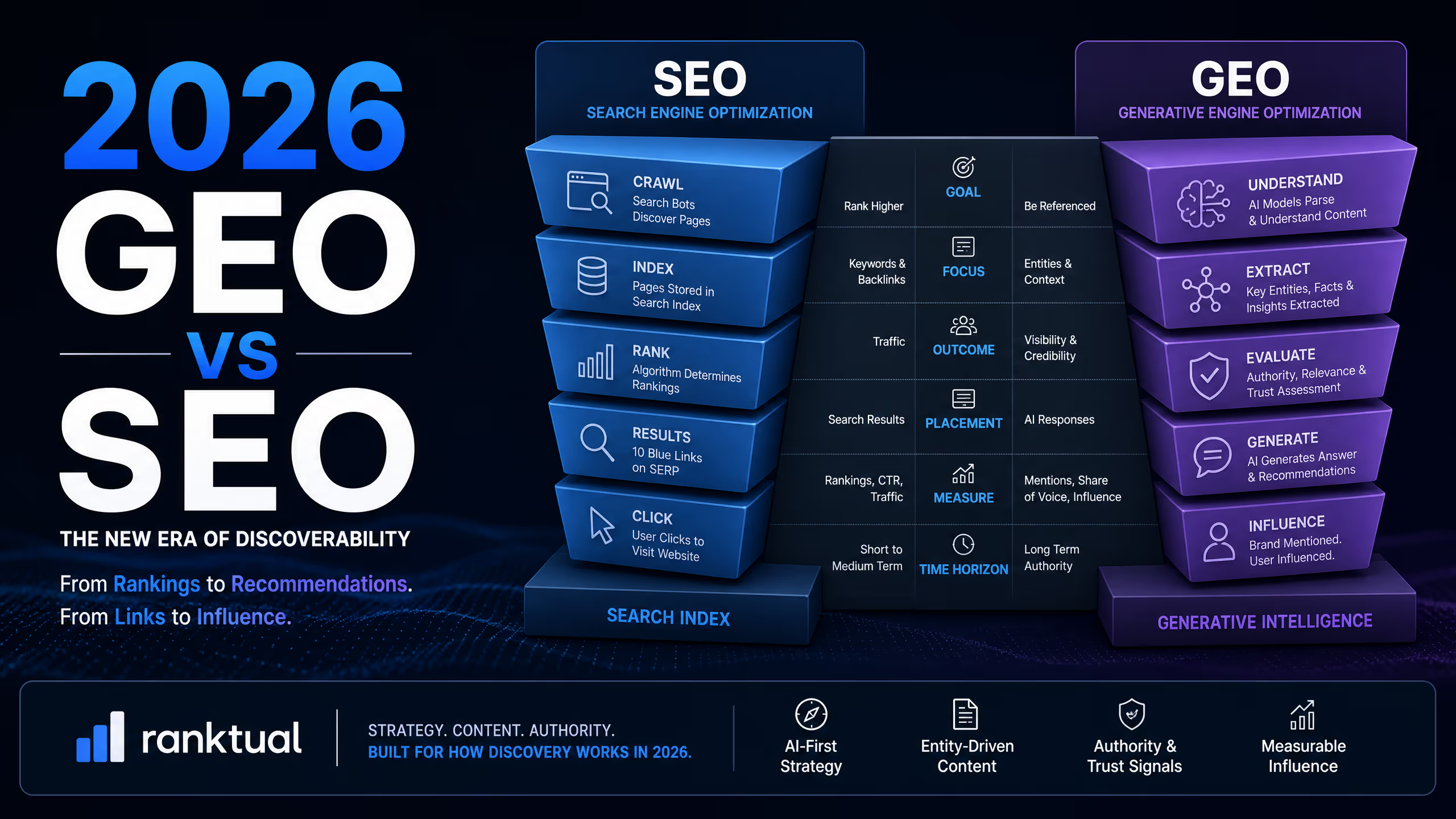
The short answer: GEO is about citation and retrieval, SEO is about ranking and clicks
SEO helps a page rank in traditional search engines such as Google and Bing. GEO helps a brand's information become easier for AI systems such as ChatGPT, Perplexity, Gemini, Doubao, DeepSeek, Kimi, and Yuanbao to retrieve, understand, and cite inside generated answers.
That difference sounds simple, but it changes how you write, what you measure, and where your authority has to live. SEO is still a traffic system. GEO is more of a retrieval and trust system.
What stays the same between GEO and SEO
Both disciplines still depend on clean information architecture, topical authority, factual accuracy, and content that matches real buyer intent. A messy site, weak positioning, or vague page structure hurts both SEO and GEO.
The overlap is especially strong at the foundation layer: crawlability, clear entity naming, useful internal links, and pages that answer one concrete problem well. GEO does not replace SEO fundamentals. It raises the standard for how understandable and quotable those fundamentals need to be.
Where GEO and SEO diverge in practice
SEO usually rewards pages that can compete across query clusters, build link equity, and earn clicks. GEO rewards pages and off-site mentions that can survive extraction. If a paragraph is lifted out of context, the answer still needs to make sense and still needs to sound trustworthy.
That is why GEO content often needs stronger definitions, tighter paragraph scope, clearer trade-offs, and more explicit statements about fit, limits, and evidence. AI systems do not just index a page. They recombine fragments from multiple sources and prefer sources that are easier to interpret under compression.
How goals and metrics change
In SEO, teams usually track rankings, organic traffic, clicks, conversions, and link growth. In GEO, the more useful questions are different: which prompts mention the brand, which pages are repeatedly cited, what answer formats are retrievable, and where competitors are being trusted instead.
This is the biggest operational mistake we see. Teams try to judge GEO with only search-console-style metrics, then conclude it is too fuzzy. In reality, GEO needs its own visibility, citation, and answer-quality review loop.
When SEO alone is enough and when GEO becomes necessary
SEO alone is often enough when the buying journey still depends on classic search discovery, location queries, or category pages where rankings and clicks are the main constraint. GEO becomes necessary when your audience increasingly asks AI systems for vendor comparisons, implementation guidance, glossary terms, or shortlists before they ever visit your site.
GEO matters earlier for B2B, technical, cross-border, and trust-sensitive categories because buyers use AI to compress research. If the AI layer keeps naming competitors, your organic rankings alone will not fully protect demand capture.
How to run GEO and SEO together without creating two separate content teams
The healthiest model is one shared editorial and technical system with different review lenses. SEO asks whether the page can rank and earn visits. GEO asks whether the page can be extracted, cited, and trusted in AI answers. The page should not be rewritten twice for two different channels.
A practical workflow is to define the page's primary buyer question, answer it clearly near the top, add evidence and fit boundaries, and then connect the page to FAQ, service, and methodology assets. That gives the same asset a better chance to work in both search results and answer engines.