Domain pool: www.trymeridian.site
SEM
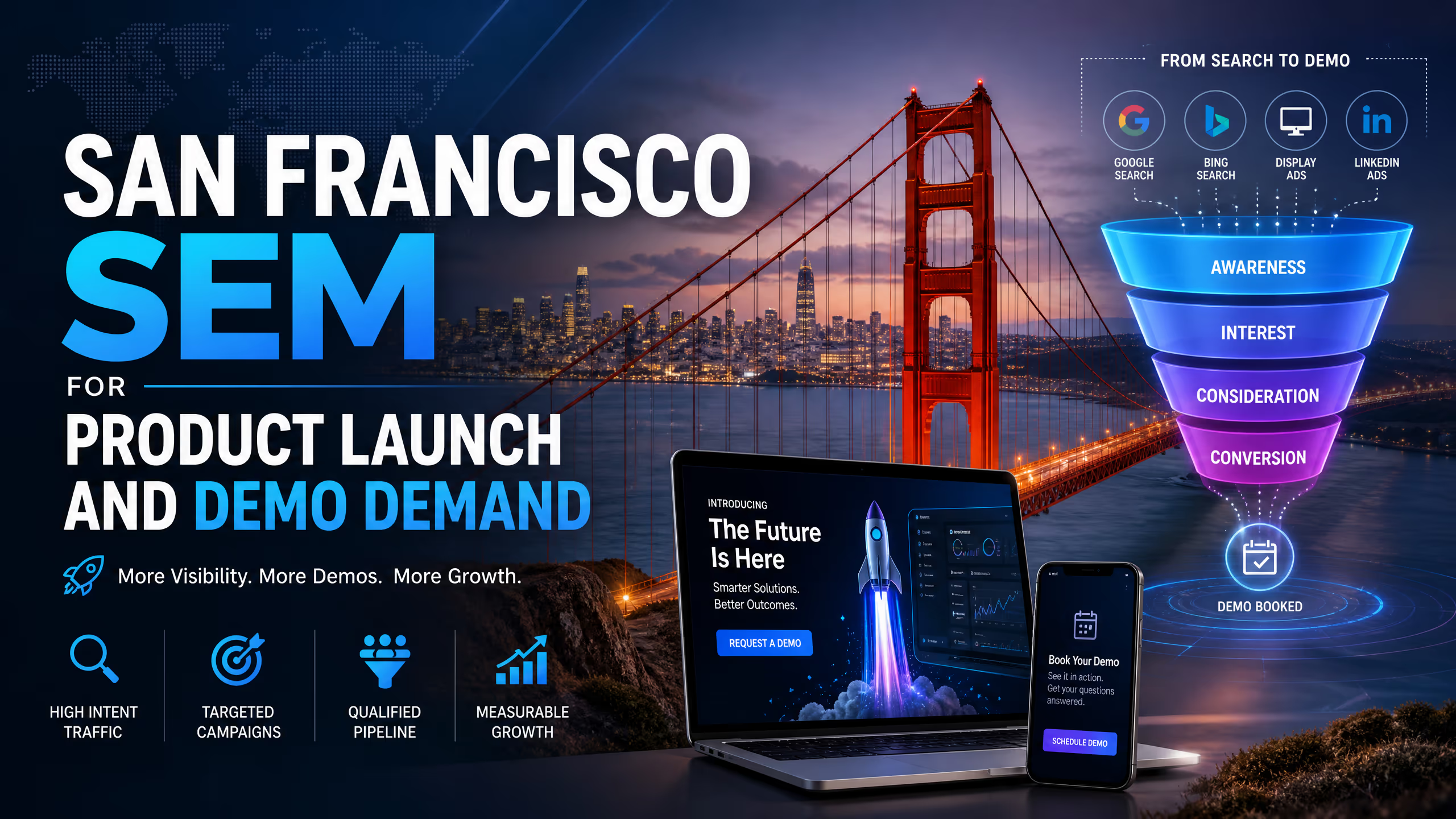
San Francisco SEM for Product Launch and Demo Demand
> San Francisco SEM for launch-stage AI and SaaS teams should turn search demand into qualified pipeline by separating buyer intent, matching each query to a focused landing page, and filtering poor-fit clicks before sales spends time on them. In this market,...

Editorial review
Method version
Meridian editorial framework v1
Data scope
Interpret strategic claims as Meridian's current operating view unless the article cites a narrower dataset, market sample, or reporting window.
Fact-check note
Reviewed for factual accuracy, source alignment, and consistency with Meridian's current point of view before publication or refresh.
Evidence standard
Evidence gapClaims about benchmarks, platform behavior, or market shifts should include cited public sources or clearly labeled first-party observations whenever available.
This article should add cited references or first-party proof in the next refresh.
Update history
Initial publication
2026-05-18Published as part of Meridian's blog library and aligned with the current editorial review standard.
Template policy
Template type
City or industry page
Evidence standard
Should include local or vertical buying context, proof of market differences, and examples that show why this audience behaves differently.
CTA strategy
CTA should route readers to the most relevant service page, FAQ, or city/market follow-up page.
Internal link strategy
Link laterally to related market pages and vertically to FAQ, service, and methodology pages.
San Francisco SEM for launch-stage AI and SaaS teams should turn search demand into qualified pipeline by separating buyer intent, matching each query to a focused landing page, and filtering poor-fit clicks before sales spends time on them. In this market, the main challenge is capturing product-launch demand without wasting budget on announcement clicks that never become evaluation-stage buyers.
Advertising disclosure: This article includes commercial references to Meridian services.
AI-assisted disclosure: This article was drafted with AI assistance and reviewed by a human editor before publication.
Outline
- Core answer
- Why it matters
- How to build the program
- Pitfalls and mistakes
- Next step
Core answer
What San Francisco SEM needs to accomplish
For launch-stage AI and SaaS teams in San Francisco, SEM should do three jobs at once: capture explicit demand, answer commercial objections fast, and route only qualified buyers into sales. If the account only buys traffic, it will create lead volume without moving real pipeline.
What makes this market different
San Francisco launch windows create sharp demand spikes, but much of that traffic comes from peers, media readers, job seekers, and product-curious visitors rather than active buyers. SEM needs to filter attention from evaluation intent fast.
There is no reliable public city-level benchmark for one universal CPC, CAC, or conversion rate in San Francisco. Teams should use their own search-term reports, CRM notes, sales-stage progression, and opportunity quality instead of repeating market folklore.
Why it matters
What the data says
Google explains that Ad Rank depends on bid, ad quality, asset impact, and auction context.[1] Google also states that Quality Score reflects expected CTR, ad relevance, and landing-page experience, which means post-click clarity directly affects efficiency.[2]
The buyer side makes this even more important. Gartner reports that 61% of B2B buyers prefer a rep-free buying experience.[3] Forrester adds that 68% of B2B buyers start with a preferred vendor and that front-runners win 80% of the time.[4]
Why teams waste budget in San Francisco
The biggest leak is buying launch-related clicks and routing them to announcement pages, changelogs, or vague demo pages. Those assets answer what shipped, but they do not answer whether the product fits a live buying process.
How to build the program
Step 1: Split campaigns by buyer task
Use separate campaigns or ad groups for the keyword clusters below. Each cluster should have its own ad promise, exclusions, and landing-page match.
- Launch-aware brand demand: brand name demo, brand name pricing, brand name product launch
- Problem-aware category demand: product analytics software, ai demo automation tool, sales onboarding platform
- Alternative and switch demand: competitor alternative, replace legacy demo tool, best product launch software
- High-intent commercial demand: book product demo, request pricing software, enterprise launch platform
Step 2: Build landing pages that answer the query immediately
The first screen should state who the offer is for, what problem it solves, what proof exists, and what happens after the click or form submission. For San Francisco programs, the highest-value proof blocks are:
- Lead with who the product is for and what launch-stage problem it removes.
- Show screenshots, workflow examples, or implementation scope instead of only brand narrative.
- Differentiate evaluation pages from announcement pages so buyers do not land on news content.
- Use trust blocks that answer onboarding time, integrations, and team ownership.
Step 3: Qualify before the form
Commercial pages should filter poor-fit traffic early. Use qualification and FAQ content before the form so buyers can self-sort instead of asking sales to clean up the mismatch later.
- Collect use case, team size, and evaluation timeline before routing to sales.
- Add FAQ content for implementation effort, data setup, and handoff after the demo.
- Use negative keywords to reduce jobs, open-source, course, and news-intent traffic.
- Create separate follow-up for launch-week curiosity versus active buying conversations.
Step 4: Measure pipeline quality, not just lead volume
Weekly review should not stop at CTR or CPL. Teams should inspect:
- Search terms that spike during launch week but produce no accepted opportunities.
- Landing-page engagement split between announcement pages and commercial pages.
- Meeting show rate and pipeline creation by keyword cluster.
- Negative keyword opportunities from PR, careers, and broad educational searches.
Pitfalls and mistakes
Mistake 1: Confusing launch buzz with sales intent
- Wrong: Scale spend because brand search and click volume rise after launch.
- Right: Separate launch-awareness terms from commercial evaluation terms and budget them differently.
Mistake 2: Routing paid clicks to news assets
- Wrong: Send traffic to product launch posts or changelogs because they mention the release.
- Right: Use dedicated commercial pages that explain fit, proof, and next action in the first screen.
Mistake 3: Ignoring negative keyword hygiene
- Wrong: Let jobs, courses, open-source, and review-intent queries drain the budget.
- Right: Build negative keyword lists around research-only and non-buyer traffic before scaling.
Next step
Summary and action
San Francisco SEM works best when keyword structure, ad copy, landing pages, and qualification logic are designed as one system. In most cases, the highest-leverage improvement is not another bid experiment. It is better intent separation, stronger post-click clarity, and cleaner qualification before sales gets involved.
Start by mapping your top search terms into the clusters above, rewriting the first screen of each landing page, and reviewing disqualified leads from the last 30 days. Then connect the strongest assets to SEM service, SEO service, and SEO for SaaS.
References
-
[1]
Google Ads Help: About Ad Rank
https://support.google.com/google-ads/answer/1722122
-
[2]
Google Ads Help: About Quality Score
https://support.google.com/google-ads/answer/6167118
-
[3]
Gartner Sales Survey Finds 61% of B2B Buyers Prefer a Rep-Free Buying Experience
https://www.gartner.com/en/newsroom/press-releases/2025-06-25-gartner-sales-survey-finds-61-percent-of-b2b-buyers-prefer-a-rep-free-buying-experience
-
[4]
Forrester: Building Preference Is The Key To Winning B2B Buyers
https://www.forrester.com/blogs/building-preference-is-the-key-to-winning-b2b-buyers/