Domain pool: www.trymeridian.site
Agency Guide
Ecommerce SEO agency vs general growth agency: which is the better fit?
Large ecommerce brands often outgrow generic growth support before they notice it. If category pages, collection logic, non-brand search demand, and founder or brand distribution are all disconnected, a general growth agency can create activity without improving the commercial system underneath.

Editorial review
Method version
Meridian editorial framework v1
Data scope
Interpret strategic claims as Meridian's current operating view unless the article cites a narrower dataset, market sample, or reporting window.
Fact-check note
Reviewed for factual accuracy, claim-to-source alignment, and internal-link integrity before publication.
Evidence standard
Evidence gapMeridian requires cited public sources or documented first-party observations for benchmark, platform-behavior, and market claims.
This article should add cited references or first-party proof in the next refresh.
Update history
Initial publication
2026-05-18Published to capture the main problem statement and recommended next step.
Template policy
Template type
Comparison page
Evidence standard
Should state comparison criteria, trade-offs, fit boundaries, and supporting proof for each recommendation instead of relying on abstract pros/cons.
CTA strategy
CTA should help buyers choose a next step such as audit, consultation, or a more specific service route.
Internal link strategy
Link to service pages, FAQ answers, decision-stage articles, and any case page that proves the comparison in practice.
The core difference
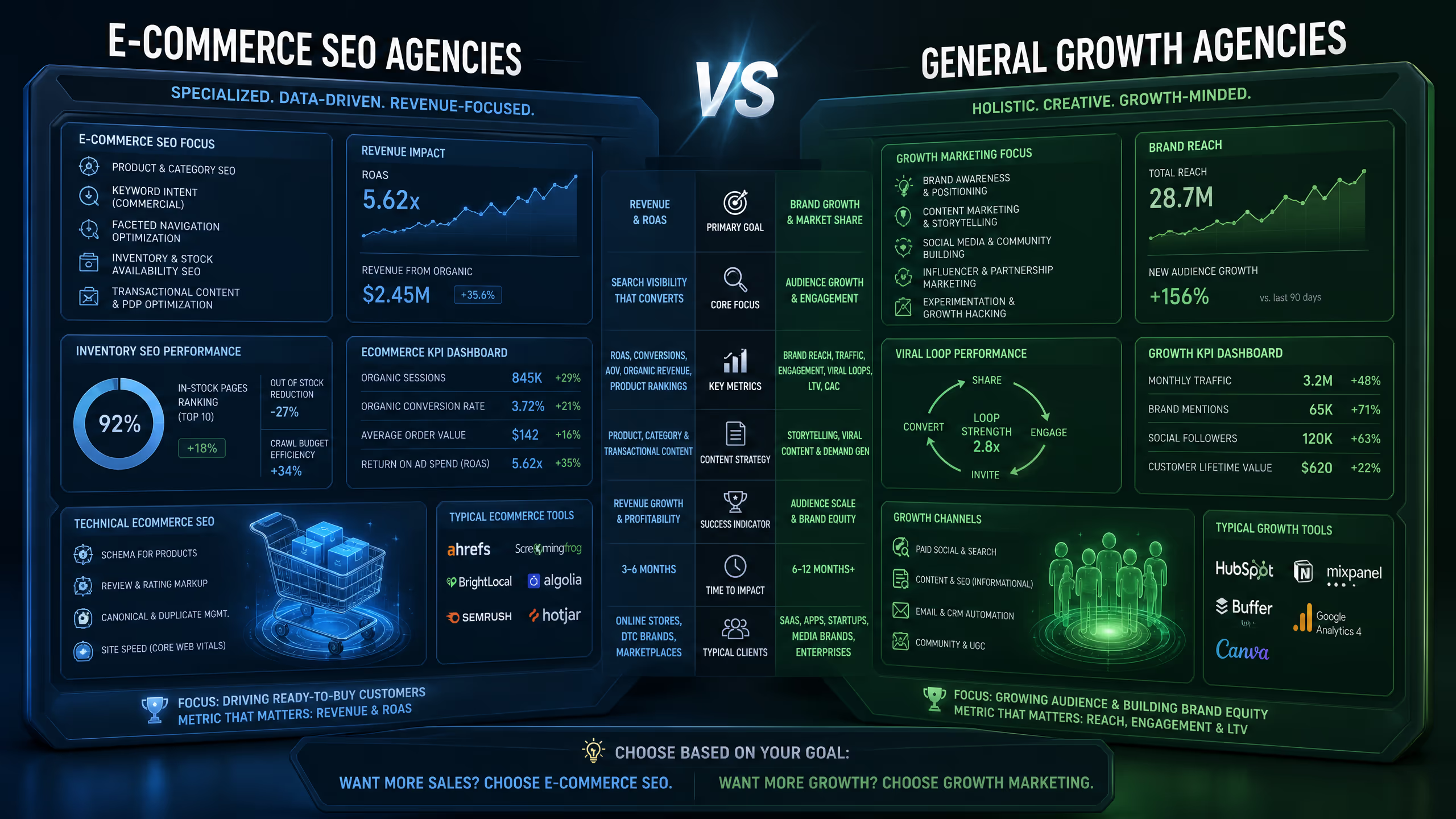
A general growth agency usually optimizes channels. An ecommerce SEO agency should optimize the demand structure behind those channels, including collection pages, category ownership, comparison intent, and supporting content.
That difference matters most once the business already has real revenue, because the cost of fragmented traffic is no longer theoretical. It directly affects margin, customer acquisition efficiency, and brand dependence.
When a general agency starts to feel too shallow
The warning signs are usually obvious: paid traffic still does the heavy lifting, collection pages do not rank for commercial demand, blog traffic does not support money pages, and the team cannot explain which pages should own which search themes.
At that stage, more campaigns do not solve the core problem. The store needs page ownership, search architecture, and a stronger content-to-revenue path.
What mature ecommerce owners should evaluate
Ask whether the agency can improve category logic, internal linking, non-brand demand capture, and decision-stage comparison pages. If it cannot, the work will likely stop at surface-level channel operations.
For cross-border brands already doing serious revenue, this is the difference between getting more noise and building a more resilient organic acquisition layer.
Where Meridian fits
Meridian is a stronger fit when ecommerce owners want more than outsourced activity. The team works best when the goal is to connect SEO structure, content systems, GEO visibility, founder or brand distribution, and execution workflows.
That is especially relevant for brands balancing search growth with international expansion, AI search visibility, and higher-pressure competition in crowded categories.
What to do next
Review your top revenue categories and ask three simple questions: which pages should rank, which pages actually rank, and which pages convert. If those answers do not line up, the store needs structural work before it needs more media activity.
That structural gap is where a specialist ecommerce SEO partner usually beats a general growth agency.